Not the digs — the standing places that carry the story of one of Judaism's Four Holy Cities. From its foundations on the Syrian-African Rift as the seat of the Sanhedrin, to early civilization sites, a noblewoman's refuge, and where a Bedouin ruler raised the walls. Follow the city's life, chapter by chapter.
How a city built over a graveyard became the capital of Jewish learning.
The story of Tiberias begins with its unique geography along the Syrian-African Rift, shaping the water dynamics of the Kinneret (Sea of Galilee) and creating unique microclimates. This geological foundation supports a city that holds the distinction of being one of Judaism's Four Holy Cities (alongside Jerusalem, Hebron, and Safed), recognized historically as the definitive seat of the Sanhedrin.
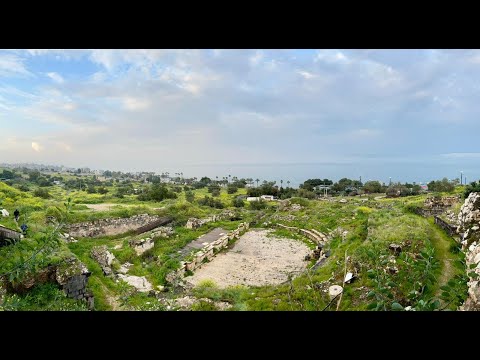
Herod Antipas built Tiberias around 20 CE as his Galilean capital, naming it for the emperor Tiberius — and unwittingly placing it over an ancient cemetery, which made observant Jews shun it at first. After Jerusalem fell and Judea emptied, that calculus flipped: the sages came north, and Tiberias became the largest Jewish city in the Galilee, where much of the Mishnah and the Jerusalem Talmud were compiled and where the Masoretes later fixed the text of the Hebrew Bible behind the Aleppo Codex. (For the excavated Roman city, see Archaeology.)
The great codifier and physician died in Egypt but was carried to Tiberias for burial — because, he wrote, the Sanhedrin would one day reconvene here. A red flame-like pergola now marks the site, near the tombs of Rabbi Yochanan ben Zakkai and other luminaries. Of all the city's tombs, this is the one historians least doubt.
The blue-domed complex above the hot springs holds Rabbi Meir "the Miracle-Worker," a leading 2nd-century sage who asked to be buried upright to greet the Redemption. On the hillside above lies the traditional tomb of Rabbi Akiva. Together they made Tiberias a place of Jewish memory long before it was rebuilt.
Conquest at Hattin, then a 16th-century attempt to rebuild a Jewish city.
The Crusaders built a new fortified Tiberias just north of the Roman town. A section of their 12th-century wall still stands in the Jewish Courtyard, once ringed by a water-filled moat. The fortress fell to Saladin in July 1187, days after his decisive victory at the nearby Horns of Hattin — a turning point for the whole Crusader kingdom.
Doña Gracia Mendes Nasi — among the richest women of the Renaissance — and her nephew Don Joseph Nasi secured Tiberias from Sultan Suleiman the Magnificent to rebuild it as a haven for Jews fleeing the Inquisition, even raising new walls by 1566. War with Venice undid the plan, but the story endures in a museum and hotel.
The immediate surroundings of Tiberias in the greater Kinneret basin are fundamental to the regional story. Encompassing nearby Mount Arbel and the Early civilization sites that dot the shoreline of the Sea of Galilee, these locations illustrate the deep Roman and Byzantine history that paved the way for the Crusader era.
A Bedouin ruler fortifies Tiberias, and the old city takes the shape you still walk today.
The Bedouin ruler Daher el-Omar fortified Tiberias around 1740, raising a black-basalt wall with 21 round turrets on Doña Gracia's earlier line. Its western stretch survives above the shops on HaGalil Street; the south-east corner's tilted "leaning tower," knocked askew in 1837, has become a symbol of the city.
At the north-west corner of the wall, Daher el-Omar's son built a two-storey basalt citadel in 1745, with four corner towers raised from reused ancient stone. Beside it stood the Seraya, the Ottoman seat of government — the administrative heart of the fortified town.
Two Ottoman-era mosques remain from the walled city — the El-Omari (Great) Mosque and, right on the waterfront, the al-Bahri "Sea Mosque," whose minaret stands among the promenade's restaurants as one of the lakefront's most photographed ruins.
Land given to Rabbi Chaim Abulafia by Daher el-Omar to draw Jews back to the city. Around the courtyard stand the Abulafia (Sephardi) Synagogue, rebuilt after the quakes of 1759 and 1837, the Karlin-Stolin and Habad synagogues — the surviving core of an old quarter whose houses were cleared after 1948.
The Franciscan church on the lakefront stands on Crusader foundations and is shaped like the upturned hull of a fishing boat, in tribute to Peter the fisherman. Inside, the symbols of the four Gospels; in the yard, a copy of the Rome statue of St. Peter.
In 1885 the Scottish doctor and minister David Watt Torrance opened a mission hospital treating all faiths, moving in 1894 to the basalt compound that today is the celebrated Scots Hotel. The modest St. Andrew's church and its garden still host concerts — a quiet relic of Tiberias's Victorian chapter.
On New Year's Day 1837 a violent earthquake toppled the walls and flattened most of Tiberias, killing around 600 people. Almost everything you see in the old city post-dates that day; the leaning tower and the cracked synagogues are its scars. Modern pioneers established nearby kibbutzim like Degania, transforming the region's demographic landscape throughout the 20th century. Today, the surviving walls, mosques, churches and synagogues are protected landmarks.