Every major dig in and around the city — the Roman theater, the early mosque, the lost palace of Antipas, the boat in the lake. Plus the Antiquities Authority that watches over it all. Honest about which you can actually visit.
Every licensed dig, salvage excavation and protected ruin in the country runs through the IAA (רשות העתיקות). Around Tiberias it has prepared the city's archaeological park, overseen the major excavations, and laid the Sanhedrin Trail — a 70 km marked route from Tiberias to Beit She'arim tracing the Galilee of the Mishnah and Talmud.
The capital Herod Antipas built around 20 CE, layer on layer to the 11th century.
The heart of the ancient city, ~120 dunams at the southern entrance: the Roman southern gate flanked by twin round towers, the basalt-paved cardo built for Roman carriages, and a bathhouse heated not by fire but by the town's hot springs. Prepared by the IAA for the municipality, opened 2008.
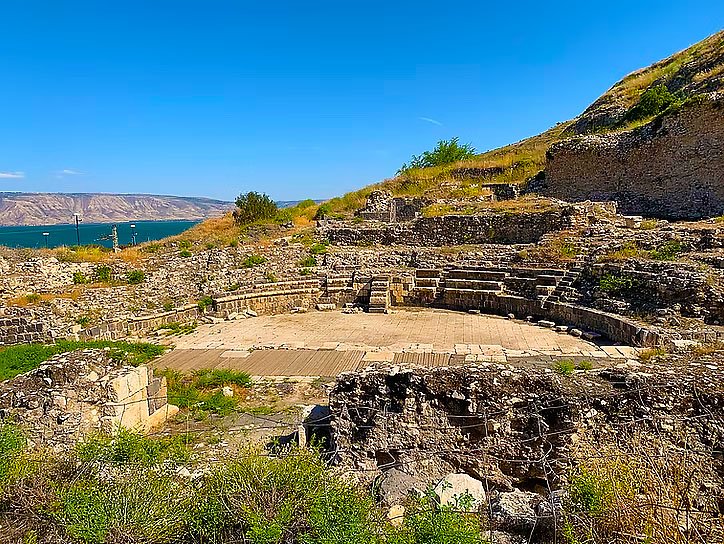
Built in the 1st century and enlarged in the 2nd, seating around 7,000 — one of the largest and best-preserved theaters of its kind found in Israel, set on the southern slope with a commanding view of the lake. Excavated and partly reconstructed; not regularly open to visitors.
One of the oldest mosques in the world. Long mistaken for a Byzantine market, the pillared congregational mosque has been re-read since 2009 by Dr. Katia Cytryn-Silverman of the Hebrew University — its basalt column bases reuse Roman-era Jewish tomb doors, and its proportions echo the Great Mosque of Damascus.
The grand palace of the man who founded Tiberias and named it for the emperor Tiberius. Archaeologists are still working to pin its exact location among the southern ruins — one of the city's great unfinished questions.
A rare Byzantine church on the hill above town, excavated by Prof. Yizhar Hirschfeld, named for the large stone anchor found beneath its altar. Mosaics here have been vandalized, and parts have been re-covered to protect them — but the hilltop view over the lake remains.
The original Roman gate, flanked by twin round towers — the very gate Vespasian ordered widened when his troops couldn't pour through during the Great Revolt, per Josephus. Still standing at the park's southern overlook.
The lake's shoreline is one long archaeological record — Bronze Age to Byzantine.
A 2,000-year-old wooden fishing boat — the "Jesus Boat" — exposed in the lakebed mud during the drought of 1986 and painstakingly conserved. Now the centerpiece of the Yigal Allon Museum at Kibbutz Ginosar, just north of Tiberias.
A first-century synagogue on the northwest shore — and the carved Magdala Stone found within it — in the town that gave Mary Magdalene her name. Uncovered from 2009, now a visitor site at Migdal.
One of the largest fortified cities of the ancient Near East, around 5,000 years old, at the southern tip of the lake where the Jordan flows out — its distinctive "Khirbet Kerak ware" pottery is known across the region.
Two sites on the north shore compete to be the lost town of Bethsaida. At el-Araj, excavators have uncovered a Byzantine church some believe is the "Church of the Apostles." A genuine open archaeological debate, dug season by season.
Some of the deepest things buried here aren't dug up — they're read every day. Tiberias is where the Masoretes fixed the vowel-points (nikud) of written Hebrew, where the standard text of the Hebrew Bible behind the Aleppo Codex was settled, and where the fixed Hebrew calendar took shape. The Sanhedrin sat here in its final centuries. The city beneath the city is also a city of letters.